
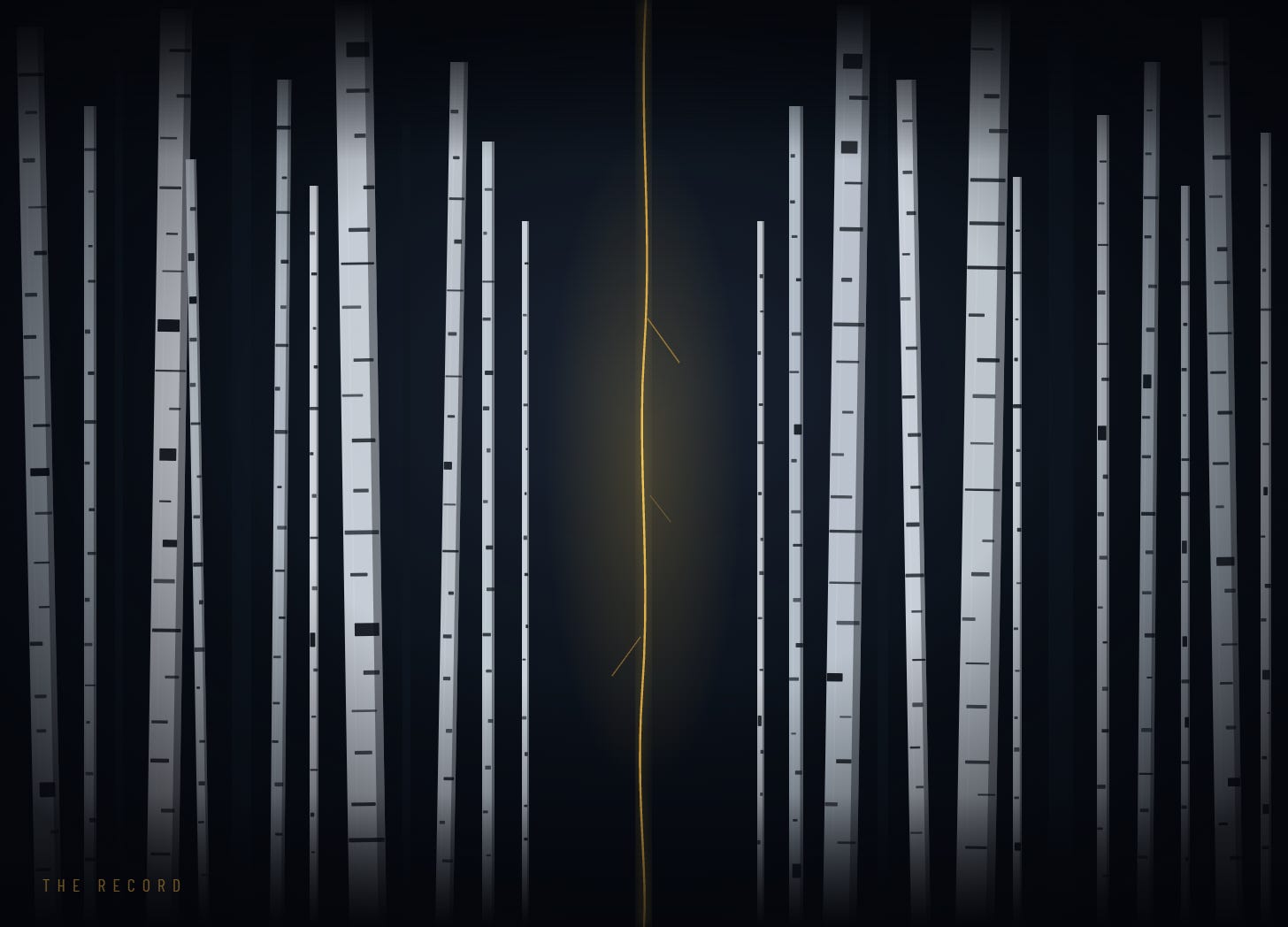
There is a science fiction novel by Liu Cixin called The Dark Forest. Its central idea is bleak and hard to shake off. The universe, it argues, is a forest at night full of armed hunters. Every civilization is one of them. You cannot know another civilization’s intentions, and you cannot know how fast its technology will grow, so the rational move when you detect someone else out there is to stay hidden and, if you can, to strike first. Announcing yourself is suicide. Trust is a luxury no one can afford. The forest stays dark because every hunter in it has done the same math and reached the same answer: silence is survival.
I have thought about that book more than I expected to, because I spent a decade inside a system built on the exact same starting conditions that reached the opposite conclusion.
Financial crime is a dark forest. Every institution sees only its own slice of the money. No bank can see what a customer does at the bank across town, no one can verify another institution’s intentions, and the people laundering money survive precisely by living in the gaps between those partial views. When I file a suspicious activity report, I am almost always working from a fragment. Someone moves money in a way I cannot explain from my seat. I do not know whether the institution on the other side already cleared the customer months ago. I do not know whether they will file too. I file anyway.
By the logic of the dark forest, I should not. Revealing what I see is costly and uncertain and might be wrong. The customer might be a guy with a weekend hot dog stand. The rational hunter stays quiet.
The Bank Secrecy Act took that same forest and changed three things, and the three changes are the entire game.
First, it made the reporting mandatory. You do not get to decide whether suspicious activity is worth the trouble. If you see it, you file it.
Second, it protected the people who report. A filing is not an accusation, and the law says so. You cannot be sued for filing a report in good faith, even if the customer is just a guy with a weekend hot dog stand. The cost of being wrong in the cautious direction was deliberately set to near zero.
Third, it put the danger on silence. The institution that files a report that goes nowhere is fine. The one that saw the same activity and said nothing is the one an examiner comes for. The risk was moved off the people who speak and onto the people who stay quiet.
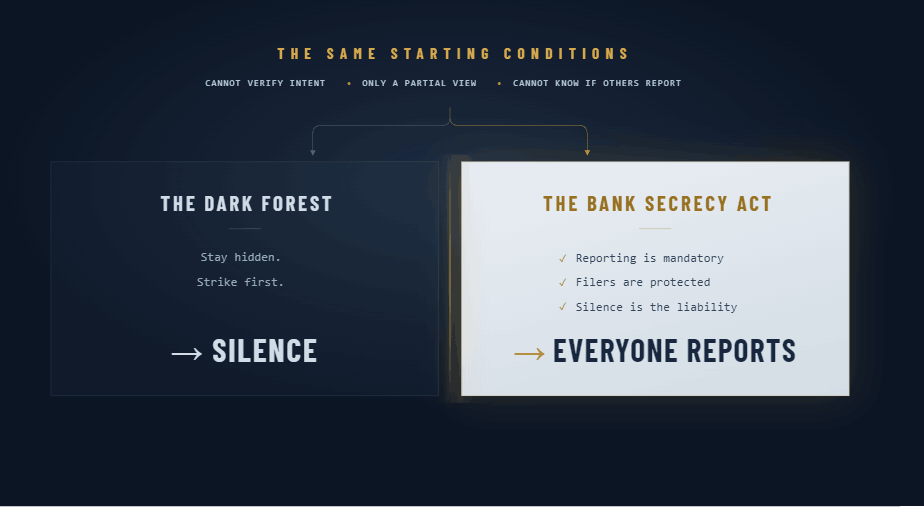
Look at what those three rules do to the arithmetic every institution is running. The cost of a false alarm drops to almost nothing. The cost of staying silent becomes the thing that can end you. So everyone files. Not because they trust each other, and not because any one of them can see the whole board. They file because the same uncertainty that keeps Liu Cixin’s forest silent has been wired, here, to make staying quiet the most dangerous move on the table.
And here is the part I find genuinely beautiful, the part almost nobody outside compliance ever sees. The system does not require anyone to see the whole picture. It does not need a central eye watching everything at once. It only needs every partial view to be written down and pooled in one place. Each report is one hunter describing the patch of forest in front of him. Stack enough of them and the aggregate sees what no single hunter ever could. That is coordination under adversarial conditions, with no central trust and no shared sight, and a statute from 1970 quietly solved a working version of a problem that game theorists still write papers about.
Once you can see the mechanism, you start noticing the forests it could light.
Recently the heads of the largest AI companies asked Congress to require screening and recordkeeping on synthetic DNA. Strip away the subject matter and it is the banking model, proposed for the one corner where the worst case is a mushroom cloud. They are asking the government to make the reporting mandatory, to protect the labs that do it, and to make silence the liability. They are right, and the interesting thing is that the shape of their request is more than fifty years old.
The same three rules apply anywhere a small number of actors can see a pattern of harm that no one else can, and have no particular reason to look. A platform can watch what its own system feeds a person for two years. When that person does something terrible, investigators will comb his accounts for intent, and the one party with the clearest view of the pattern is the one with no obligation to ask whether it played any part. That is a dark forest too. You do not light it by proving a specific company caused a specific tragedy, and you do not light it by banning a kind of speech. You light it the way the Bank Secrecy Act did. Make the reporting mandatory. Protect the people who do it. Put the risk on silence.
The dark forest is a theory about why intelligent actors who cannot trust each other end up alone and quiet. The Bank Secrecy Act is the counterexample sitting in plain sight. It is proof that you can take the same actors, the same uncertainty, the same inability to verify anyone’s intentions, and build a system where the rational move is to speak.
We have been running that experiment in finance for more than half a century, and it works. Everywhere else the forest is still dark, it is dark by choice.